Terraform Interview Questions
Revision | Date | Description |
|---|---|---|
| 24.07.2024 | Init Changelog |
Introduction
This guide will provide beneficial insights and help you understand the most important areas of Terraform, whether you are an interviewer attempting to assess a candidate’s knowledge or a candidate wanting to demonstrate their abilities. Let us dive into the world of Terraform to look at the Terraform Interview Questions that can be used to determine a user’s level of knowledge and familiarity with this powerful IaC tool.
Being able to efficiently manage and automate resources has become crucial to modern DevOps and cloud engineers as cloud computing keeps growing. HashiCorp’s open-source Terraform infrastructure as code (IaC) structure is now a top choice for safely and efficiently provisioning, managing, and versioning infrastructure. Engineers can set up resources in both the cloud and on-premises with Terraform through the generation of human-readable configuration files that can be shared, reused, and versioned. Its broad backing for cloud service providers renders it a flexible tool for handling different infrastructure situations.

What is Hashicorp Terraform?
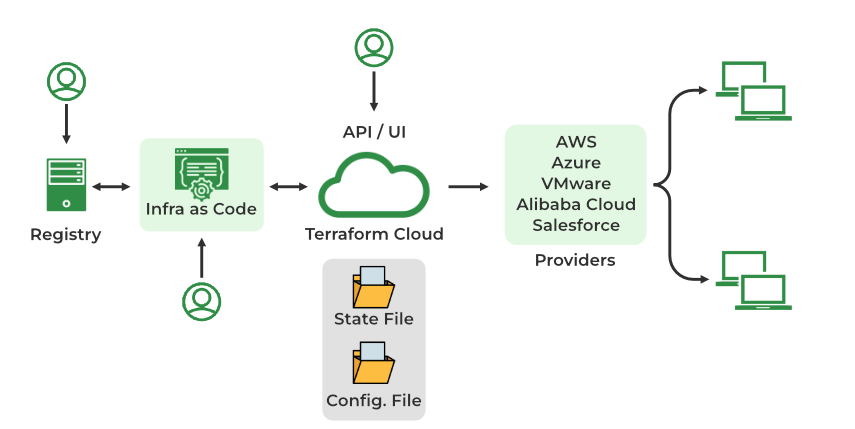
Terraform is an open-source infrastructure as code (IaC) software tool which can be used to provision the infrastructure of a cloud platform. The scripts which have been used to provision infrastructure can be human-readable configuration files that can be versioned, reused, and shared. You can use wide provision wide range of resources in the cloud by using terraform like compute, storage, networking, and application services, across a variety of cloud providers and on-premises environments.
The language used in Terraform is declarative type where you can just mention the required state no need of mentioning how to achieve that desired state. Wit the help of the state file terraform will create, modify, or destroy resources.
What is Infrastructure as a Code (IaC)?
Infrastructure as Code (IaC) is a method of managing and provisioning IT infrastructure using code, rather than manual configuration. It allows teams to automate the setup and management of their infrastructure, making it more efficient and consistent. This is particularly useful in the DevOps environment, where teams are constantly updating and deploying software. To know more about Infrastructure as a Code (IaC).
Basic Terraform Interview Questions
Basic Terraform interview questions aim to assess a candidate’s understanding of fundamental concepts and their ability to use Terraform effectively. These questions typically cover topics such as the purpose and benefits of Terraform, its configuration language (HCL), the workflow of writing and applying infrastructure as code, and the basics of managing resources and providers.
What is Terraform and what is its primary purpose?
HashiCorp developed the open-source infrastructure as code (IaC) technological advances Terraform. The primary goal is to use a declarative configuration language to define, use, and manage cloud infrastructure resources. Automated and consistent deployments across multiple cloud providers and services are made feasible via Terraform.
How do you install Terraform?
Download the appropriate information package for your operating system from the official Terraform site to install Terraform. Move the Terraform binary to a directory which forms part of your system’s
PATHfollowing opening the downloaded package. Run the terminal lineterraform –versionto verify the installation.What are Terraform Providers?
Plugins referred to as Terraform Providers allow Terraform to communicate with an array of external APIs and services. The lifecycle of resources within a specific service, such AWS, Azure, or Google Cloud, is handled by each provider. Terraform may utilize resources and data sources which have been established by providers. For defining infrastructure across multiple platforms, they are essential.
Explain the basic structure of a Terraform configuration file.
HCL (HashiCorp Configuration Language) is employed to structure a Terraform configuration file. It is made up of parts like variable for input variables, resource to define resources, provider to determine the cloud provider, and output to extract and display values. Parameters and values defining infrastructure settings and components are provided in each block.
What is a Terraform state file?
A Terraform state file is a
JSONfile that maintains track of the infrastructure that Terraform is at present maintaining. It maintains records of resources, dependencies, and configurations, helping Terraform plan modifications and make sure the infrastructure complies with the given code. This file is essential to preserving infrastructure consistency and understanding changes.How do you initialize a Terraform configuration?
Use the command terraform init in your terminal within the configuration directory to initialize a Terraform installation. This command sets up the backend, downloads the necessary provider plugins, and sets the working directory ready for additional Terraform activities. Before performing the application, verify that your configuration files are configured correctly. It is essential to set up prior applying or organizing changes.
What is the purpose of the terraform plan command?
An execution plan, that describes the steps Terraform will take to get to the target state defined in the configuration files, is generated using the terraform plan command. It helps in evaluating enhancements prior to execution, ensuring that no unforeseen modifications are produced to the infrastructure. By specifying any modifications, deletions, or additions to assets, this command enhances safety and predictability.
How do you apply a Terraform configuration?
Go to the directory wherever your Terraform files are saved before deploying a configuration. Following that, use
terraform initto initialize the working directory. Review the terraform implementation plan after that. Finally, useterraform applyto make the changes, and when prompted, confirm by typingyes.What is the use of the terraform destroy command?
To remove each asset listed in your Terraform configuration, execute the terraform delete command. It removes Terraform-provided infrastructure, making sure that none is left behind. This command is crucial for resource cleanup, preventing wasteful spending, and maintaining a clean infrastructure environment. If you want to manage infrastructure as code workflows to promote efficient cycles during development, testing, and deployment, this stage is necessary.
Explain the concept of a “resource” in Terraform.
An infrastructure a component whether a virtual machine, DNS record, or cloud provider service, is commonly referred to as a "resource" in Terraform. It describes the features and setup of the infrastructure object which is to be managed. Terraform configuration files offer definitions for resources, that are then produced, altered or removed in accordance with the states that have been defined there. They act as the basic units to manage and provisioning infrastructure as code.
Who are some key players that compete with Terraform in the infrastructure as code (IaC) market?
Pulumi: An open source tool that lets you write infrastructure code using programming languages you know.
AWS CloudFormation: With its native IaC includes and customized layout for AWS environments, CloudFormation directly competes Terraform’s multiple clouds support.
Google Cloud Deployment Manager: Given its ability to develop and deploy complex infrastructure configurations, Google’s solution poses an important danger to Terraform’s cross-platform capabilities.
Azure Resource Manager (ARM): Within the Azure setting, Microsoft’s ARM templates offer an effective alternative for Terraform by enabling the efficient definition and provision of Azure resources.
How does the Terraform core operate?
HashiCorp Configuration Language (HCL) configuration files are processed by Terraform core in order for it to function. Based on the configurations, it then creates a dependency trees of infrastructure resources. Then, it arranges and performs out changes to the infrastructure state that correspond to the planned configuration. Finally, it updates the state file to reflect the infrastructure’s visible state.
What does IAC mean?
Infrastructure as Code is referred to as IAC. It describes the method for employing machine-readable definition files, as compared to interactive configuration tools or actual hardware configuration, for managing and providing computing infrastructure. IAC is an essential part of modern DevOps procedures since it makes infrastructure deployment and management simpler, consistent, and accessible. Procedures are streamlined, errors decrease, and collaboration between the development and operations teams is promoted.
What are the reasons for employing Terraform within DevOps practices?
By simplifying infrastructure as code, Terraform enables resource provisioning foreseeable and consistent. It enhances collaboration via modularization and version leadership. By automated improvements to infrastructure, Terraform reduces the likelihood of error by humans and ensures dependability. Its expressive style makes scaling infrastructure easier and make configuration management easier.
What is the purpose and functionality of the null_resource in Terraform?
If a task in Terraform does not directly relate to a resource, it can be executed with the null_resource placeholder. It allows the utilization of triggers or provisioners without creating any actual infrastructure. For running local-exec directions or coordinating operations among resources, this can be useful. In basic terms, it offers flexibility in the scheduling of tasks that are not incorporated into the typical resource lifecycle.
Intermediate Terraform Interview Questions
After attempting the basic one in this intermediate Terraform interview questions we will explore more complex aspects of Terraform usage. These questions may cover topics such as state management, handling multiple environments, and integrating Terraform with other tools and services.
How can you manage different environments (e.g., dev, prod) using Terraform?
Create distinct state files for each setting when employing Terraform for managing multiple environments. Making use of separate directories or Terraform workspaces for each setting. To parameterize parameters for configurations across environments, utilize variables. To effectively manage and track changes across environments, implement a version control system.
Example:
# Define variables for environment-specific settings variable "environment" { default = "dev" } # Use conditionals to create resources based on environment resource "aws_instance" "example" { count = var.environment == "prod" ? 2 : 1 # Other configurations... }What are Terraform modules and how do they help?
Infrastructure configurations are contained in reusable components named Terraform modules. They improve the reusability and maintainability of Terraform code by simplifying and separating it. Modules enhance collaboration and scalability in infrastructure as code projects by dividing up complex infrastructure into smaller parts. Modules make infrastructure deployment and management simpler through providing a uniform method for defining resources in different environments.
Explain the difference between
terraform applyandterraform plan -out.The infrastructure changes that Terraform will make appear in the Terraform plan. Terraform apply implements those alterations. An execution plan is generated using
terraform plan -outand stored to a file for use with terraform apply at a later date. It makes it possible to talk about and review the plan prior to making any modifications.What are remote backends in Terraform?
Terraform’s remote backends, such Amazon S3 or Azure Blob Storage, are locations of storage where Terraform stores its state files. They ensure consistent state management across environments and promote team member interaction. Terraform assists in maintaining infrastructure consistency and enables safer collaboration on infrastructure as code projects by remotely storing state.
How do you handle secrets in Terraform?
Using Terraform’s Vault or AWS Secrets Manager to manage secrets. Maintain your Terraform code without any hardcoding secrets. For dynamic secret injection, employ Terraform input variables or environment variables. For more security, put up strong encryption and access control systems.
What is Terraform’s
taintcommand used for?When a resource instance is marked as tainted through the Terraform taint command, it must be destroyed and renewed on the next occasion to apply. It is used to trigger the recreation of a specific asset as a result of issues or configuration changes. Tainting ensures uniformity in deployments and aids in maintaining of infrastructure integrity. Whenever identifying or updating specific resources within an infrastructure which is managed using Terraform, this tool come in useful.
How do you use Terraform to provision infrastructure on AWS?
Generate Terraform configuration files which describe AWS resources utilizing the HashiCorp Configuration Language (HCL).
Use
terraform initto initialize Terraform in the project’s directory.To preview changes, use
terraform plan; to provide resources, useterraform apply.Use version control to track changes while employing
terraform statecommands to handle the position of the infrastructure.
What is the purpose of the
terraform validatecommand?Before deployment, the Terraform validate command checks whether the configuration files are appropriate. It checks provider compatibility, validates resource references, and checks for errors in syntax. This preemptive measure ensures smooth infrastructure provisioning and helps avoid deployment mistakes.
Explain the use of
countandfor_eachin Terraform.In Terraform, a
countfunction can be used to generate many resources of the same kind via a numerical value. On the other hand, resources can be automatically produced withfor_eachbased on amaporsetof strings. While resource repetition is managed by both,for_eachoffers greater flexibility with dynamic configurations.How do you import existing infrastructure into Terraform?
Use the
terraform importcommand, resource type, and resource ID to import existing infrastructure into Terraform.terraform import aws_instance.example i-1234567890abcdef0provides an example such that. With this command, your Terraform setup is linked to the present infrastructure. Finally, changes may be deployed and evaluated utilizingterraform applyandterraform plan.What exactly is meant by a "Private Module Registry"?
Within a company, a Private Module Registry acts as a secure location for managing and storing software modules. Teams may distribute and share code all through the company with tight control over access and permissions. In basic terms, it is a central repository for reusable code libraries which are only accessible by people in a certain company or group. This guarantees effective cooperation, security, and consistency in software development campaigns.
Can Terraform be utilized to manage infrastructure that is hosted on-premises?
Yes, Terraform can employ custom scripts or providers like VMware or OpenStack to manage on-premises infrastructure. It enables version control and automation via infrastructure as code practices. It ensures scalability and consistency in on-premises and cloud environments.
Can Terraform deploy resources across multiple providers?
Terraform can, if fact, simultaneously deploy resources across many providers. Terraform may manage resources from multiple cloud and infrastructure providers in a single configuration via provider plugins. It makes it possible to manage heterogeneous environments effortlessly, which streamlines installation and infrastructure management processes.
How can Terraform handle and disregard duplicate resource errors when executing a terraform apply command?
Terraform can accept duplicate resource errors during
terraform applyowing to the-ignore_duplicateswitch. By setting on this setting, Terraform continues to operate even when it encounters duplicate resources, ensuring continuous deployment. This capacity improves reliability and automation, especially for complex infrastructure setups.Could you describe the different parts that make up Terraform’s architecture?
CLI (Command-Line Interface): This is the primary user interface via which users can tell Terraform to manage infrastructure.
Core Engine: The core engine takes actions that provide and upkeep the infrastructure by understanding configurations written in JSON or HashiCorp Configuration Language (HCL).
Providers: Terraform has the ability to manage resources across multiple infrastructure platforms (like AWS, Azure, etc.) via providers communicating via their APIs.
State Management: Terraform keeps a state file containing the current status of the managed infrastructure, enabling it to precisely determine any changes that have to be performed in later runs.
Advanced Terraform Interview Questions
We have reached the end of the Terraform interview questions and in this advanced section, we have covered intricate aspects such as state management, remote backends, and the effective use of workspaces. Candidates might be asked to explain the nuances of Terraform modules and how to design reusable, maintainable infrastructure code.
What are Terraform’s built-in functions and how can they be used?
Data formatting, arithmetic calculations, and string manipulation are among the inherent capabilities of Terraform. These let users validate inputs, rapidly modify data structures, and generate configuration values on the spot. Examples include the content formatting method
format(), the map value retrieving methodlookup(), and the list of element accessing methodelement(). These features enable Terraform more adaptable and allow better infrastructure as code solutions.How do you manage Terraform configurations in a CI/CD pipeline?
Apply tools like Terraform Cloud or AWS CodePipeline for streamlined management and collaboration, keep Terraform configurations in a version-controlled repository, employ automated scripts to trigger Terraform runs, and use infrastructure as code principles for consistent deployments when integrating Terraform configurations into your continuous integration and continuous delivery pipeline.
Explain the concept of "resource lifecycle" in Terraform.
The process that a resource follows from creation to deletion are referred to as the resource lifelong in Terraform. Planning, making modifications, and exhausting assets are all part of it. In order to ensure that infrastructure is provisioned and managed efficiently and consistently, Terraform oversees these stages. Understanding the life span of resources is essential for proficient automation and administration for infrastructure.
How does Terraform handle dependencies between resources?
Terraform utilizes both explicit and implicit declarations in its configuration files to manage resource dependencies. For deciding which resources should be provisioned or current first, it employs a dependency graph. Dependencies can be provided by users using resource references in their configuration or through using the
depends_onassets. The provisioning process is then managed by Terraform in accordance with, ensuring that resources are produced or changed in the correct sequence.What are Terraform workspaces and how do they differ from modules?
Utilizing Terraform workspaces, you may oversee multiple environments—such as development, staging, and production—within a single configuration. On the other hand, modules are reusable Terraform configuration construction fragments that let you bundle and share infrastructure parts. While workspaces emphasize environment isolation, modules enhance the upkeep and reusability of applications.
How do you debug and troubleshoot Terraform configurations?
Before applying, utilize
terraform planto preview changes to identify potential issues.Using
terraform validateto make sure that configurations are properly established and to check syntax.For ongoing consistency, read and handle the state file with the
terraform statecommands.For extensive knowledge into the process flow and errors, use Terraform’s verbose mode, error messages, and logging capabilities.
What is the significance of the
terraform refreshcommand?By employing the terraform refresh command, you are provided that Terraform will automatically detect and react to any changes in the infrastructure that your configuration controls. It makes an analogy with the infrastructure’s current state with the state specified in the Terraform state file. Running this command will ensure that Terraform is in sync with any manual changes performed outside of Terraform and that the infrastructure is accurately represented as it is now. It is essential to keep infrastructure as code since it ensures consistency all through environments.
How do you write custom Terraform providers?
To develop custom Terraform providers, handle state management, implement CRUD operations, provide resource schemas in Go, and conform to testing and authentication constraints set out in the Terraform SDK.
Explain the use of
terraform statecommands.Terraform state commands monitor the state file which stores your infrastructure’s present state. Each asset in the state appears on the Terraform State List. Terraform State Show offers details on a certain resource. Terraform state mv moves a resource to an alternative address, while terraform state rm removes a resource from the state file. Terraform utilizes these commands to maintain and update its understanding of your infrastructure.
What are the best practices for structuring Terraform configurations?
Use modules to effectively organize resources by enclosing comparable duties.
Employ outputs and variables to parameterize and save the configuration.
For clarity, utilize naming conventions for modules and resources.
Take advantage of Terraform environments and workspaces for managing multiple deployments.
What is the concept of state file locking, and how does it work?
A method named state file locking is employed to stop several processes or threads from reading a shared file at the same moment. A process which intends to modify a file locks it downward, rendering it difficult for other processes to access it until the lock is released. This protects against racial situations and ensures data integrity.
How do you manage and address setbacks or errors that occur during a process?
When difficulties appear, I start by collecting all the facts is a cool, collected manner. I then figure out the underlying cause and swiftly come up with a plan for fixing it. Since communication is vital, I strive to be open with all parties involved while seeing the experience as a chance to learn for future improvements.
How do Terraform and Ansible differ in terms of their functionalities and use cases?
Terraform is a cloud environment management software that focuses mainly on declarative configuration files for infrastructure provisioning. On the other the side, Ansible is a configuration management the solution focusing on automation and simplicity of use for handling duties across numerous servers and installing software. Ansible is excellent at configuration management and application deployment, while Terraform is excellent at infrastructure as code. Together with each other, both of these tools provide an effective framework for complete IT automation.
How do you go about updating plugins within Terraform?
You can use the
terraform init -upgradecommand in Terraform to update plugins. This command ensures that the most recent versions of all plugins are installed. On the other together, you can directly set the plugin version in the settings files. Never remember to test and endorse changes before applying them in real-life situations.